Effective Ransomware Protection Strategies for Businesses: Comprehensive Prevention, Detection, and Recovery

Ransomware is malicious software that encrypts or exfiltrates business data to extort payment, and effective ransomware protection requires integrated prevention, detection, and recovery strategies that minimize downtime and financial loss. This guide explains how ransomware operates, identifies the primary threats facing small to mid-sized businesses, and maps actionable controls—technical, procedural, and human—that reduce breach likelihood and speed recovery. Readers will learn concrete steps for implementing multi-factor authentication, endpoint detection and response, network segmentation, robust backup and encryption architectures, employee training programs, and incident response planning. For organizations seeking managed support, Wahaya IT — a Baton Rouge-based managed technology provider — offers tailored Cybersecurity, Business Continuity, Managed Services, and Cloud Migration capabilities to augment in-house controls while maintaining local responsiveness. The article proceeds by outlining key threats, proactive technical defenses, backup and encryption best practices, employee awareness programs, incident response planning, and the benefits of AI-enhanced managed services for continuous ransomware protection. Throughout, emphasis is placed on measurable outcomes: reduced dwell time, lower recovery costs, and improved resilience.

What Are the Key Ransomware Threats Facing Small to Mid-Sized Businesses?

Ransomware threats combine accessible attack vectors with increasingly commoditized capabilities, making SMBs attractive targets due to limited defenses and valuable data. Attackers deploy phishing campaigns, ransomware-as-a-service (RaaS), exposed remote desktop protocol (RDP) endpoints, and exploitation of unpatched software to gain initial access and escalate privileges. These methods enable encryptors, double-extortion variants that leak data for blackmail, and hybrid leak/blackmail attacks to maximize pressure on victims. Understanding these threat patterns helps organizations prioritize defenses that block entry points and limit adversary movement across networks.

Ransomware impacts hinge on speed and scope: faster detection reduces encryption spread and lowers recovery costs, while broad lateral movement increases operational downtime. The following bullets list the top threats and their practical implications for SMBs.

  • Phishing campaigns deliver malicious attachments or credential-stealing links that initiate compromise.
  • Ransomware-as-a-service packages empower less-skilled actors to deploy sophisticated payloads.
  • Exposed RDP and poorly secured remote access facilitate easy entry into internal systems.
  • Unpatched or legacy software provides exploitable vulnerabilities for privilege escalation.
  • Double-extortion and data leak strategies increase regulatory and reputational exposure.

These threat vectors underscore why layered technical controls and training are essential to arrest initial access and escalation. Effective detection and backup strategies are the next critical defenses to reduce operational and financial harm.

How Does Ransomware Impact Business Operations and Finances?

Ransomware disrupts operations by encrypting critical systems and halting workflows, often causing prolonged downtime for key business functions. Direct financial impacts include ransom payments, forensic investigation costs, restoration and remediation expenses, and potential regulatory fines when protected data is exposed. Indirect costs arise from lost sales, customer remediation, reputational damage, and increased insurance premiums, which can cumulatively exceed ransom demands. Recent incident analyses show that extended downtime amplifies labor and recovery costs, so reducing dwell time directly lowers total loss exposure.

Quantifying risk helps prioritize investments: businesses should evaluate potential downtime scenarios against acceptable recovery time objectives (RTOs) and recovery point objectives (RPOs) to guide backup and continuity design. Understanding financial consequences leads to more effective contingency planning and faster return to operations after an incident.

Why Are Small Businesses Particularly Vulnerable to Ransomware Attacks?

Small businesses are often targeted because limited IT budgets and lean staffing leave security gaps that attackers exploit, such as delayed patching, weak access controls, and unsegmented networks. Legacy systems and third-party integrations can expand the attack surface, while insufficient cybersecurity training increases employee susceptibility to phishing and credential theft. Attackers scan for common weaknesses—open RDP, misconfigured cloud storage, or exposed administrative interfaces—and then leverage those footholds for lateral movement and encryption.

A simple vulnerability checklist can help SMBs identify risk: missing multi-factor authentication, absent endpoint detection tools, no immutable backups, and irregular security assessments. Addressing these gaps with prioritized controls reduces attacker success rates and strengthens resilience against modern ransomware techniques.

Which Proactive Cybersecurity Solutions Prevent Ransomware Infections?

Proactive controls combine identity protections, endpoint defenses, email filtering, and network design to reduce initial compromise and lateral spread. Multi-factor authentication blocks credential-based access even when passwords are phished, endpoint detection and response (EDR) tools identify suspicious behavior before encryption, and email security filters stop malicious attachments and links. Network segmentation and Zero Trust principles restrict lateral movement, while regular vulnerability assessments and patch management remove exploitable weaknesses. Implementing these measures in concert provides layered protection that is far more effective than isolated controls.

Below is a comparison of leading preventative technologies to help SMBs weigh deployment options and operational trade-offs.

The table compares common preventative technologies and their practical attributes:

TechnologyPrimary FunctionTypical SMB Deployment Consideration
Endpoint Detection and Response (EDR)Detects and responds to endpoint threats in real timeRequires agent rollout and tuning; high detection value for desktops and servers
Multi-Factor Authentication (MFA)Adds a second authentication factor to accountsLow friction for users with authenticator apps; blocks most credential attacks
Email Filtering & Anti-PhishingBlocks malicious attachments and phishing URLsCloud or gateway-based filters reduce phishing volume; needs ongoing rule updates
Network Segmentation / MicrosegmentationLimits lateral movement after compromiseCan be implemented gradually; VLANs and access policies reduce blast radius

This comparison shows that combining identity, endpoint, email, and network controls delivers the best prevention posture. The next sections unpack how to implement two of these controls—MFA and segmentation—in practical terms.

How Does Multi-Factor Authentication Enhance Account Security?

Multi-factor authentication (MFA) enhances account security by requiring an additional verification factor beyond a password, which greatly reduces successful credential-based breaches. MFA works by combining knowledge factors (passwords) with possession factors (authenticator apps or hardware tokens) or inherence factors (biometrics), making it much harder for attackers to authenticate even when credentials are stolen. Statistically, MFA can prevent the vast majority of automated password compromise attempts, and practical rollouts typically start with privileged accounts and remote access services, then extend to all user logins.

A phased MFA rollout for SMBs begins with inventorying high-risk accounts, enabling MFA for administrative and remote access, communicating changes to users, and providing clear user support. Common pitfalls include relying solely on SMS for second-factor delivery—where possible, favor authenticator apps or hardware tokens for stronger security and fewer interception risks. Successful MFA adoption measurably reduces account takeover incidents and complements endpoint controls to prevent lateral escalation.

What Role Does Network Segmentation and Zero Trust Architecture Play in Defense?

Network segmentation and Zero Trust architecture reduce ransomware impact by limiting the pathways an attacker can use to move between systems after initial access. Segmentation separates critical assets—like file servers, backups, and domain controllers—behind stricter access controls, while Zero Trust applies continuous verification for every access request regardless of network location. Together these principles ensure that compromise of one workstation does not automatically grant access to sensitive infrastructure, thereby containing potential encryption or exfiltration.

Practical steps for SMBs include identifying critical assets, grouping systems by function, applying least-privilege access policies, and enforcing segmentation with firewalls or access controls. A textual diagram helps: place user endpoints in one zone, servers and databases in a protected zone, and backup appliances in an isolated zone with tightly controlled access. This containment strategy reduces blast radius and speeds recovery by preventing widespread encryption across zones.

How Can Businesses Implement Robust Data Backup and Encryption Strategies?

Robust backups and comprehensive encryption form the last line of defense, ensuring recoverability and reducing incentives to pay ransoms. Effective backup strategies combine local snapshots for quick restores, offsite cloud replicas for geographic redundancy, and immutable backups to prevent tampering after compromise. Encryption protects data confidentiality both at rest and in transit, while secure key management and regular testing validate that backups will restore when needed. Together, backup and encryption strategies minimize data loss and maintain business continuity.

Below is a comparison of backup approaches with recovery expectations and suggested use-cases for SMBs.

Backup ApproachRetention / RTORPOSuggested Use-Case
On-site Backups (snapshots)Short RTO for quick restores; local risk of compromiseMinutes to hoursRapid file recovery and short-term rollback
Cloud Backups (replicas)Moderate RTO depending on bandwidth; offsite safetyMinutes to hoursOffsite resilience and disaster recovery
Immutable Backups (air-gapped/immutable snapshots)Higher assurance against tampering; longer restore planningMinutes to hoursProtection against backup encryption and ransomware tampering

This table illustrates how combining on-site speed, cloud redundancy, and immutability yields a resilient recovery posture. The next subsections define the 3-2-1 backup rule and discuss encryption specifics that protect data integrity and confidentiality.

When businesses evaluate managed options for backup and continuity, Wahaya IT’s Business Continuity and Cloud Migration capabilities can provide managed replication, immutable snapshot configurations, and tested recovery playbooks tailored to local Baton Rouge environments.

What Is the 3-2-1 Backup Rule and Why Is It Critical?

The 3-2-1 backup rule requires keeping at least three copies of data on two different media types, with one copy stored offsite, and it prevents single points of failure that ransomware can exploit. Specifically, maintain the primary data, a local backup (for fast restores), and an offsite or cloud copy (for disaster recovery), and incorporate immutable snapshots or air-gapped copies to block tampering. Testing restore procedures regularly validates that RTOs and RPOs are achievable and that backups remain trustworthy after a compromise.

Implementing 3-2-1 with immutable backups reduces the chance that attackers can encrypt or delete all copies, while offsite replication ensures geographic redundancy. Regular verification and periodic restoration drills convert theoretical resilience into functional preparedness.

How Does Data Encryption Protect Business Data from Ransomware?

Data encryption protects confidentiality by rendering exfiltrated or stolen data unreadable without the appropriate cryptographic keys, reducing leverage from data theft. Encryption should cover data at rest (disk and backups) using robust standards like AES-256 and data in transit (TLS) to prevent interception, while key management practices—secure key storage, rotation, and separation of key custodianship—preserve cryptographic effectiveness. Cloud providers and managed backup solutions often support server-side encryption and customer-managed keys, which gives organizations control over access to encrypted archives.

Strong key management prevents attackers from using stolen backups, and encrypting endpoints and backups together ensures that even if adversaries exfiltrate copies, those artifacts are useless without keys. Aligning encryption scope with backup strategies ensures both recoverability and reduced exposure from data theft.

What Are Effective Employee Training and Awareness Practices Against Ransomware?

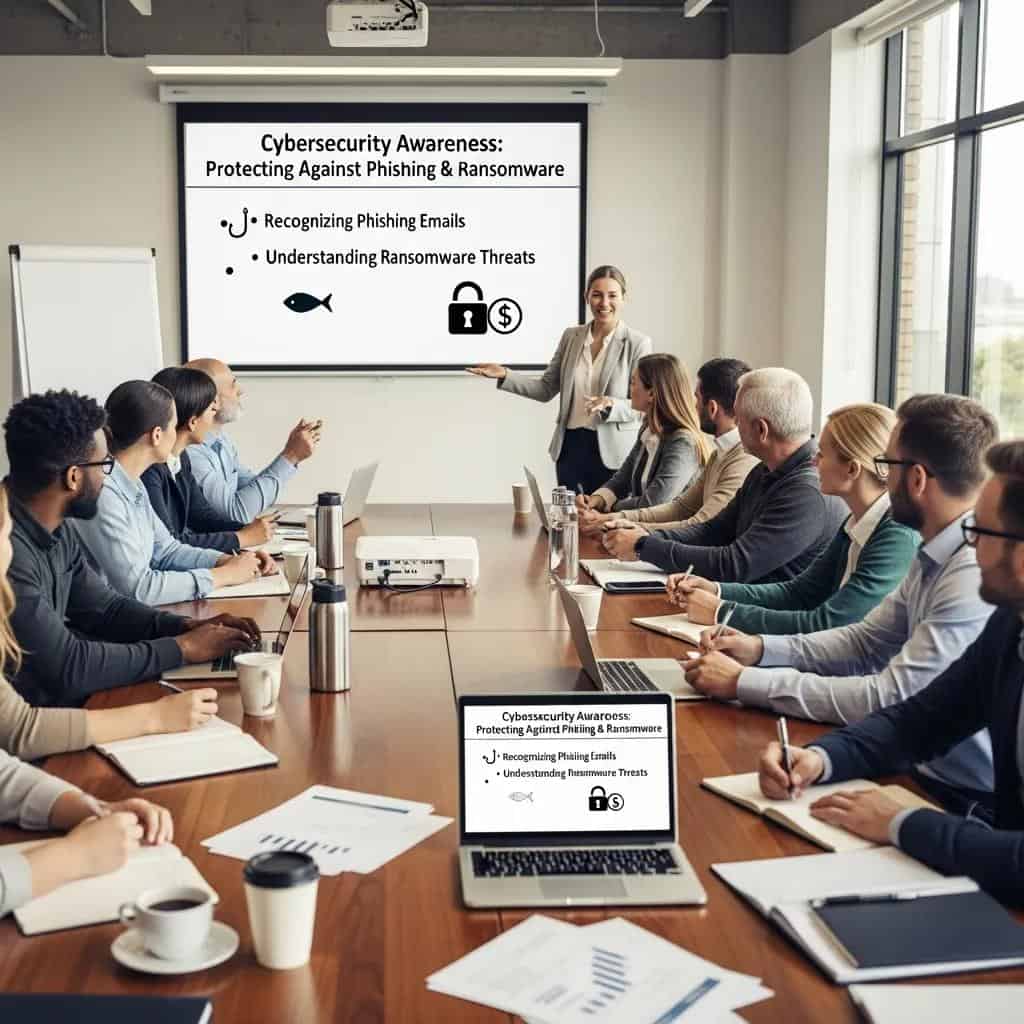
Human-focused defenses are essential because phishing and social engineering remain primary ransomware entry methods. Effective programs combine role-based training, realistic phishing simulations, and clear reporting and remediation workflows so employees can recognize, report, and contain suspicious messages. Training should be ongoing, include microlearning modules, and measure key performance indicators (KPIs) such as click-through rate, reporting rate, and completion rates to demonstrate continuous improvement. Embedding security awareness into organizational culture and policy ensures that technical controls are reinforced by informed user behavior.

Below is a recommended set of practices to shape an effective security awareness program that directly reduces ransomware risk.

  1. Quarterly phishing simulations: Assess susceptibility and tailor individual training based on results.
  2. Monthly micro-learning modules: Short lessons reinforce behaviors and keep security top-of-mind.
  3. Clear reporting pathways: Provide a simple process for users to flag suspected phishing for rapid investigation.

These practices create measurable improvements in employee vigilance and decrease the probability of successful social-engineering attacks, which pairs with technical controls to close common attacker vectors.

How Does Phishing Awareness Reduce Ransomware Risks?

Phishing awareness reduces ransomware risk by lowering the probability that employees will engage with malicious content that leads to credential theft or malware execution. Realistic simulations educate users on identifying red flags—unexpected attachments, sender anomalies, mismatched URLs—and track response behavior to focus remedial training. When employees report suspicious messages quickly, incident response teams can block malicious senders and contain threats before widespread compromise.

A formal remediation workflow ensures that flagged messages trigger automated scanning, user notifications, and targeted follow-up training, converting potential failures into learning opportunities. Regular measurement of click rates and reporting frequency demonstrates program effectiveness and informs ongoing refinement.

What Are Best Practices for Ongoing Cybersecurity Training?

Best practices for ongoing cybersecurity training include a blended cadence of quarterly simulations, monthly micro-learning, and annual role-specific deep dives, supported by leadership sponsorship and clear policies. Training content should be contextualized to job functions—finance teams receive wire-transfer phishing scenarios, while IT staff receive technical threat briefings—and performance tracked through KPIs like reduction in click rates and increase in reporting. Leadership involvement signals organizational priority and drives policy compliance, while integrating training outcomes into performance metrics promotes accountability.

A sample training calendar sequences simulations, micro-modules, and tabletop exercises to maintain readiness without overwhelming staff. Using measurable KPIs ensures continuous improvement and alignment with broader security objectives, which naturally transitions into incident preparation and response planning.

How Should Businesses Prepare for and Respond to Ransomware Incidents?

Preparation and response require a tested incident response (IR) plan that defines detection, containment, eradication, recovery, and post-incident review steps mapped to clear roles and timelines. An effective IR plan includes runbooks for common scenarios, communication templates for stakeholders, preserved forensic evidence procedures, and coordination with legal and insurance partners. Rapid containment—isolating infected hosts, revoking compromised credentials, and preserving backups—reduces spread and supports forensic analysis. Periodic tabletop exercises ensure the plan functions under stress and that all parties understand responsibilities.

The following table maps incident response phases to roles and expected timelines to help SMBs design practical playbooks.

PhasePrimary TasksTypical Timeline
DetectionIdentify indicators, alert responders, initiate triageMinutes to hours
ContainmentIsolate affected systems, suspend compromised accountsHours
EradicationRemove malware, patch vulnerabilities, validate endpointsHours to days
RecoveryRestore from clean backups, verify integrity and servicesHours to days
Post-Incident ReviewConduct forensic analysis, update playbooks, report lessons learnedDays to weeks

This mapping clarifies expectations and supports coordination between IT, leadership, legal, and external responders. The next subsections detail creating runbooks and the role of cyber insurance in recovery.

When external expertise is needed during planning or incident execution, Wahaya IT’s Incident Response, Business Continuity, and Cybersecurity managed services can provide hands-on support, orchestration of recovery, and tested playbooks tailored for Baton Rouge businesses.

What Steps Are Involved in Developing a Ransomware Incident Response Plan?

Developing a ransomware incident response plan involves defining roles and escalation paths, creating runbooks for detection and containment, establishing communication templates for stakeholders, and maintaining relationships with legal, forensic, and cyber insurance partners. A practical runbook outlines immediate steps—preserve evidence, isolate affected hosts, enable safe-mode restores—and assigns responsible individuals for each action. Regular tabletop exercises validate runbooks, expose gaps, and update procedures based on lessons learned, improving readiness and reducing recovery times.

Including backup verification steps and decision criteria for engaging external responders ensures that teams can execute recovery without delay. Clear escalation thresholds and communication protocols help maintain customer and regulatory trust during an incident, leading smoothly into considerations about insurance coverage.

How Can Cyber Insurance Mitigate Financial Losses from Attacks?

Cyber insurance can mitigate financial losses by covering costs such as incident response retainers, forensic investigations, legal fees, notification and credit monitoring expenses, and sometimes ransom payments—subject to policy terms and exclusions. When evaluating policies, businesses should prioritize coverage limits, inclusion of incident response retainer services, clarity on ransom coverage, and lists of required security controls to avoid denial. Insurers often expect evidence of proactive measures—MFA, EDR, backups—which aligns policy requirements with sound security practice.

Insurance complements technical controls and backups by defraying recovery costs, but it is not a substitute for prevention; coupling insurance with tested incident response plans and verified backups yields the most resilient financial posture after an attack. Choosing policies that include preferred incident responders streamlines engagement when time is critical.

Why Choose Managed IT Services with AI-Powered Ransomware Protection?

Managed IT and security services provide continuous monitoring, expert incident handling, and predictable costs that many SMBs cannot sustain in-house. AI-enhanced Managed Intelligence accelerates threat detection by correlating telemetry from EDR, SIEM/XDR, and network sensors to prioritize real threats and reduce false positives. For SMBs, outsourced managed detection and response (MDR) and 24/7 monitoring remove the burden of maintaining specialized staff while ensuring faster containment and remediation. Local providers can tailor services to regulatory and operational needs specific to their region, improving contextual response and support.

Below are the typical benefits SMBs realize when partnering with a managed provider that integrates AI-driven intelligence into their security stack.

  • Continuous monitoring and alert triage reduce mean time to detection and containment.
  • Access to specialist expertise without hiring senior security personnel full-time.
  • Predictable operating costs that simplify budgeting for cybersecurity and continuity.

These managed capabilities translate into measurable reductions in dwell time and operational disruption, making managed services a pragmatic choice for many small to mid-sized organizations.

How Does Wahaya IT’s Managed Intelligence Enhance Cybersecurity?

Wahaya IT’s Managed Intelligence approach integrates AI-driven detection, automated playbooks, and human oversight to accelerate threat prioritization and remediation across endpoints, logs, and backups. AI identifies anomalous patterns and correlates events to highlight high-risk incidents, while automated playbooks execute containment steps—such as isolating endpoints or blocking accounts—so responders can focus on investigation and remediation. Continuous tuning and human review reduce false positives and tailor detection to each environment, lowering dwell time and improving incident outcomes.

This blend of automation and expert oversight shortens detection-to-containment cycles, reduces manual alert fatigue, and ensures that remediation actions align with business continuity objectives. Organizations benefit from measurable outcomes such as faster recovery and fewer successful ransomware events.

What Tailored Solutions Does Wahaya IT Offer for Baton Rouge Businesses?

Wahaya IT offers a suite of managed solutions—including Managed Services, Cybersecurity, Business Continuity, Cloud Migration, Microsoft 365 support, Lifecycle Management, and Unified Communication—designed to address the specific operational and security needs of Baton Rouge businesses. Engagements typically follow assess → implement → manage models: start with a tailored assessment and roadmap, implement prioritized controls such as EDR, MFA, backups, and network segmentation, then transition to ongoing management and monitoring. Local support ensures cultural and regulatory alignment, and bundled services simplify vendor management while improving resilience.

For Baton Rouge organizations seeking a local managed intelligence provider, Wahaya IT can coordinate incident response retainers, manage immutable cloud backups, and operate AI-enhanced detection to reduce ransomware risk and speed recovery. Businesses interested in a tailored assessment can contact Wahaya IT to discuss specific needs and continuity planning.