Top IT Security Practices & Strategies for Baton Rouge SMBs

IT security is the set of practices, controls, and technologies that protect digital assets, data, and operations from unauthorized access, loss, or disruption. Small businesses in Baton Rouge face a unique mix of local threats, regulatory pressures, and resource constraints, so tailored security strategies deliver the greatest return on limited budgets. This guide explains current cybersecurity threats in 2024, foundational controls SMBs should prioritize, and practical steps to secure networks, endpoints, and cloud services while preserving business continuity. Readers will learn how layered defenses—such as multi-factor authentication, patch management, backups, and network segmentation—reduce risk, and how AI-enabled managed services can accelerate detection and response. The article maps threats to mitigations, compares backup and recovery options, outlines assessment-led customization, and describes a straightforward pathway to engage a local managed intelligence provider for ongoing security operations. Throughout, keywords like security strategies, IT security, cybersecurity practices, and ransomware protection for small business are integrated naturally to support discoverability and immediate applicability.

What Are the Top Cybersecurity Threats Facing Small Businesses in 2024?

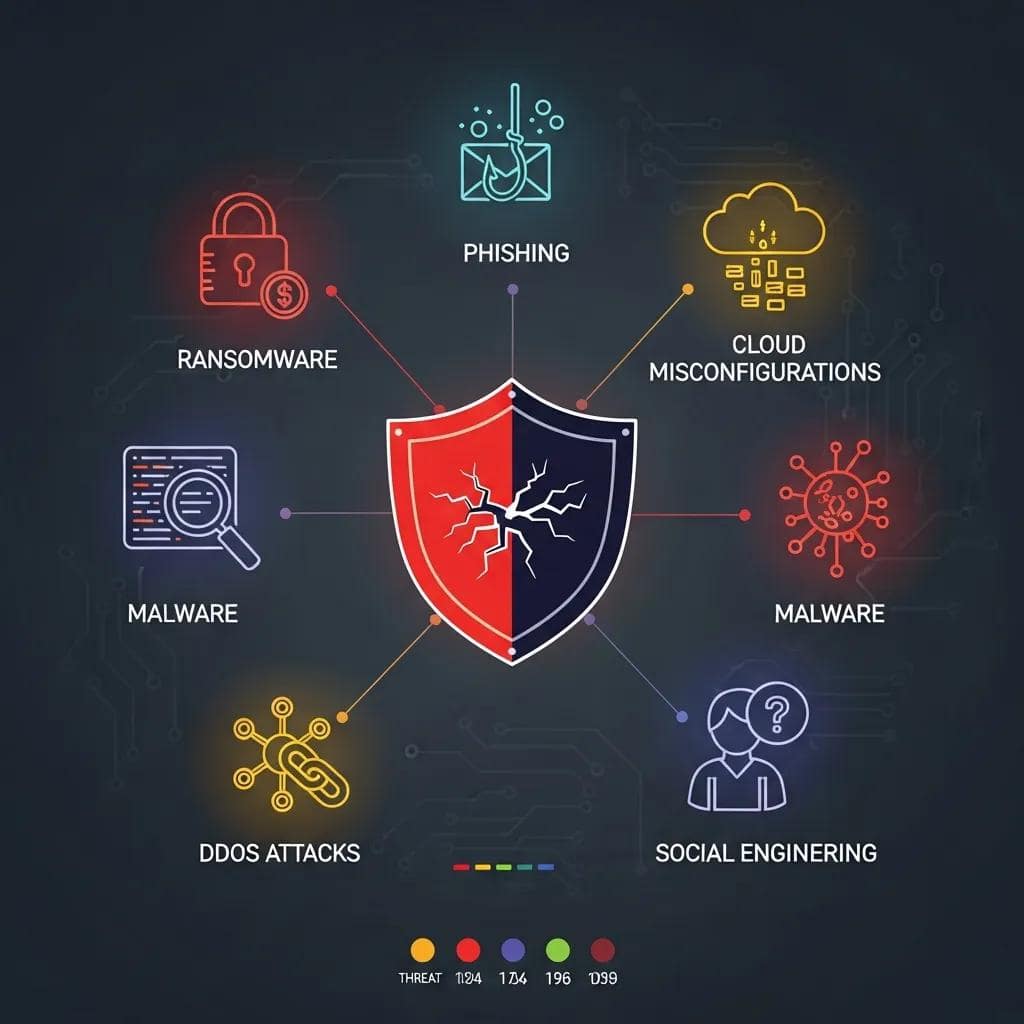
The top cybersecurity threats for small businesses in 2024 include ransomware, phishing and AI-assisted social engineering, cloud misconfigurations, supply chain compromises, and credential theft. These threats work by exploiting human error, unpatched systems, insecure cloud interfaces, and third-party dependencies, and they directly impact operations through downtime, data loss, and compliance risk. Understanding these threats helps SMBs prioritize controls that reduce exposure and improve resilience, such as layered backups, identity protections, and vendor risk assessments. The following concise list summarizes each threat with a short mitigation line to enable quick decision-making.

  • Ransomware: Use segmented backups and verified recovery to limit downtime and avoid payment pressure.
  • Phishing & social engineering: Combine phishing simulations with email filtering and MFA to reduce successful scams.
  • Cloud misconfiguration: Enforce IAM controls, configuration reviews, and automated scanning to catch insecure settings.
  • Supply chain attacks: Perform vendor risk assessments and require security attestations to limit third-party impact.
  • Credential theft: Deploy MFA, password hygiene policies, and monitoring to detect compromised accounts quickly.

This prioritized threat overview sets the stage for foundational controls that offer the highest impact per dollar invested, which we cover next.

How Does Ransomware Impact SMBs and How Can It Be Prevented?

Ransomware encrypts business data or exfiltrates information for extortion, causing operational disruption, recovery costs, and reputational harm. Attackers commonly gain access through unpatched vulnerabilities, exposed remote services, compromised credentials, or phishing, so prevention emphasizes reducing these attack vectors and ensuring recoverability. Effective controls include tested backups following the 3-2-1 principle, endpoint detection and response (EDR) to catch malicious activity, network segmentation to limit lateral movement, and timely patching to remove exploit paths. In the event of an incident, isolating affected systems, invoking disaster recovery plans, and engaging an incident response process expedite restoration and reduce overall impact.

Layering defenses reduces single points of failure and speeds recovery, and this focus on resilience naturally leads into employee-focused controls like awareness training and phishing simulations that lower successful infection rates.

What Are Common Phishing and Social Engineering Attacks to Watch For?

Phishing and social engineering remain top infection paths because they exploit human trust and context, with 2024 showing more AI-enhanced spear phishing and deepfake-enabled voice scams that increase plausibility. Common variants include credential phishing, spear-phishing targeting executives, vishing (voice phishing), and business email compromise (BEC) that manipulates invoice or vendor workflows. Indicators include unexpected requests for credentials or money, mismatched sender information, pressure to act quickly, and unusual attachment types; immediate containment steps are to disconnect suspected devices, reset affected credentials, and report incidents to IT for analysis. Regular simulated phishing, role-based training, and robust email filtering reduce click rates and shorten the window for attackers to succeed.

These human-centered mitigations complement technical controls like MFA and EDR, which together form a layered defense that reduces both initial compromise and subsequent damage.

Which Foundational IT Security Best Practices Should SMBs Implement?

Foundational IT security for SMBs focuses on high-impact, low-cost controls that significantly reduce risk: multi-factor authentication, consistent patch management, secure backups, least-privilege access, and employee training. These controls work by closing common exploit paths and limiting what an attacker can access if one control fails, and they deliver measurable reductions in successful breaches and account compromises. Prioritizing these foundational practices provides immediate protection that scales as the business adopts more advanced services. The checklist below helps SMBs prioritize actions that yield strong security gains with reasonable effort.

  1. Implement Multi-Factor Authentication (MFA) across administrative and user accounts to prevent unauthorized access.
  2. Maintain a documented patch management process to reduce exposure from known vulnerabilities.
  3. Adopt a 3-2-1 backup strategy with regular verification to ensure recoverability after incidents.
  4. Enforce least-privilege access and role-based permissions to limit lateral movement.
  5. Run regular cybersecurity awareness training and phishing simulations to reduce human risk.

The prioritized checklist demonstrates how straightforward investments can materially lower exposure; the table below compares these controls to help SMBs sequence implementation based on protection level and ease.

Different controls offer varying protection levels and implementation effort, so this comparison helps prioritize quick wins and plan longer-term changes.

ControlProtection LevelEase of Implementation
Multi-Factor Authentication (MFA)HighModerate
Patch ManagementHighModerate
Verified Backups (3-2-1)HighModerate
Least-Privilege AccessMedium-HighModerate-High
Employee Awareness TrainingMediumEasy

This table clarifies that MFA, patching, and backups typically provide the best immediate return, while access governance and cultural measures require more ongoing investment and process changes.

How Can Employee Cybersecurity Awareness Training Reduce Risks?

Employee awareness training reduces risk by changing how staff recognize and respond to phishing, suspicious activity, and policy violations, and training programs work by reinforcing secure behaviors and measuring progress through simulations. An effective program includes baseline onboarding, quarterly short modules, targeted role-based lessons for finance and executives, and monthly simulated phishing to track click rates and remediate vulnerable users. Measurable KPIs include phishing click rate, time-to-report incidents, and completion rates for required modules; trending these metrics informs program adjustments. Local SMBs in Baton Rouge benefit from training scenarios tailored to regional business practices and vendor relationships, improving relevance and uptake.

Regular reinforcement and measured improvement build a security-aware culture, which reduces successful social engineering and supports technical controls like MFA and EDR in preventing breaches.

Why Is Multi-Factor Authentication Essential for Business Security?

Multi-factor authentication (MFA) adds a second verification factor—such as an authenticator app, hardware token, or SMS code—to dramatically reduce account takeover risk by requiring more than a password to gain access. MFA is proven to stop the majority of automated credential-stuffing and phishing-initiated account compromises, particularly when applied to privileged accounts and remote access points. Deploying MFA should follow a phased plan: start with admin and high-risk users, then expand to all SaaS and VPN logins, providing fallback and recovery options for users. Integration with Microsoft 365 and common SaaS platforms is typically straightforward and delivers high-impact protection with manageable user experience trade-offs.

A phased rollout combined with user support minimizes friction and enables rapid security gains, which primes the organization for more advanced detection and response capabilities described next.

How Does Wahaya IT’s Managed Intelligence Enhance Security for Baton Rouge SMBs?

Managed Intelligence blends managed services with AI-driven analytics to surface prioritized alerts, reduce false positives, and accelerate response—helping SMBs detect threats earlier and remediate faster. This approach leverages automated correlation across endpoints, network logs, and cloud signals, and it pairs machine learning detection with human analyst review to validate incidents before escalation. For Baton Rouge SMBs, local responsiveness and tailored configuration ensure controls align with business workflows and compliance needs, making security both practical and actionable. Using a managed intelligence model also delivers cost-effective outsourced IT that consolidates network management, Microsoft 365 security, compliance services, and continuity planning into a single relationship.

Wahaya IT positions itself as a local managed intelligence provider serving Baton Rouge and surrounding areas, combining AI-powered threat detection with hands-on managed services to reduce mean time to detect and remediate. For SMBs with constrained in-house security capacity, this model provides a scalable way to implement MDR, EDR, and proactive monitoring without large upfront investments.

What Benefits Does AI-Driven Threat Detection Provide?

AI-driven threat detection identifies anomalous behavior faster by correlating signals across devices, users, and cloud services, which reduces mean time to detect and supports quicker containment. Specific benefits include automated prioritization of high-fidelity alerts, pattern recognition that uncovers stealthy attacks, and the ability to scale monitoring without proportional headcount increases. Use cases for SMBs range from detecting credential misuse to spotting lateral movement in segmented networks; however, human review remains essential to contextualize alerts and avoid over-reliance on automation. Combining AI with managed analysis achieves the benefit of speed while preserving accuracy through expert validation.

Faster, prioritized detection complements strong foundational controls such as MFA and verified backups, creating a practical operations model that reduces business disruption.

How Are Customized Cybersecurity Solutions Tailored to Local Businesses?

Customized cybersecurity solutions begin with an assessment-driven approach that profiles business assets, industry obligations, and operational risk; this informs a design that aligns controls, reporting, and SLAs to the organization’s tolerance for downtime and data loss. Tailoring considers whether a client is retail, legal, healthcare, or professional services, then maps controls—like encryption, access reviews, and specific compliance measures—to those needs. Local support models emphasize responsiveness to on-site issues and vendor coordination, while service-level agreements define monitoring cadence and escalation paths. This assessment → design → implement cycle ensures investments address the most critical risks first and adapt as the business changes.

A tailored solution reduces unnecessary complexity and focuses budget on controls that materially improve resilience, which ties directly into backup and continuity planning discussed next.

What Are Effective Data Protection and Business Continuity Strategies?

Effective data protection combines strong backup architecture, clear recovery objectives, and regular testing to ensure operations can resume after incidents, and it relies on data classification and encryption to protect sensitive information both at rest and in transit. Backup approaches (onsite, cloud, hybrid) differ by cost, recovery time objective (RTO), and recovery point objective (RPO), so SMBs should select the model that matches their tolerance for downtime and data loss. Disaster recovery planning includes defined roles, communication plans, and periodic tabletop and full-scale recovery tests to validate procedures. The following list outlines key continuity strategies SMBs should adopt to reduce outage impact and accelerate recovery.

  • Maintain verified backups with documented retention and restoration procedures to meet RTO/RPO targets.
  • Classify data to prioritize critical systems and ensure sensitive information is encrypted and access-controlled.
  • Implement Disaster Recovery as a Service (DRaaS) or hybrid recovery solutions for rapid failover where budgets allow.

Choosing the right mix of backups and recovery testing informs how to structure vendor relationships and managed services for resilient operations.

Below is a comparative table showing typical RTO/RPO expectations and recommended solutions for common backup approaches to aid selection.

Backup strategies vary in cost and recovery speed; matching business priorities to expected RTO/RPO helps select an appropriate solution.

Backup ApproachTypical RTO / RPORecommended Solution
Onsite backupsRTO: hours - days / RPO: minutes - hoursLocal NAS with offsite replication and regular verification
Cloud backupsRTO: hours / RPO: minutes - hoursEncrypted cloud snapshotting with automated retention policies
Hybrid (onsite + cloud)RTO: under 2 hours / RPO: minutes3-2-1 strategy with replication and DRaaS for critical systems

This comparison shows hybrid options often deliver the best balance of speed and cost for SMBs, and managed services can simplify implementation and testing.

How Can Robust Data Backup and Disaster Recovery Safeguard Your Business?

Robust backup and disaster recovery safeguard businesses by ensuring that critical systems and data can be restored within defined RTO and RPO targets, limiting revenue loss and customer impact. Best practices include following the 3-2-1 rule (three copies, two media types, one offsite), encrypting backup sets, performing regular restore tests, and documenting recovery procedures for each critical application. Recommended RTO/RPO examples for SMB scenarios often target RTOs under 24 hours for critical services and RPOs of minutes to hours depending on transactional volume. Regular testing and post-test remediation close gaps and keep the recovery plan current with infrastructure changes.

Consistent validation and documentation reduce surprises during incidents and make vendor-managed recovery options more reliable, which aligns with the managed service examples outlined in the next table.

What Steps Are Involved in Developing an Incident Response Plan?

An incident response plan follows six phases—prepare, identify, contain, eradicate, recover, and lessons learned—and assigns clear responsibilities, communication channels, and escalation triggers to each phase. Preparation includes asset inventories, escalation lists, and playbooks for common incidents such as ransomware and data breaches; identification relies on monitoring and defined alert thresholds, while containment uses network isolation and access revocation to limit spread. Eradication involves patching and cleaning affected systems, recovery uses validated backups to restore services, and lessons learned feed back into controls and training to prevent recurrence. Outsourcing parts of the IR lifecycle—like forensic analysis and legal/PR coordination—can accelerate response for SMBs without in-house expertise.

A simple IR playbook and regular tabletop exercises transform plans into practiced responses, reducing downtime and reputational harm when incidents occur.

How Can SMBs Secure Their Networks, Endpoints, and Cloud Environments?

Securing networks, endpoints, and cloud environments requires layered technical controls aligned to budget and operational complexity: firewalls and segmentation reduce lateral movement, EDR and patching protect endpoints, and cloud configuration management and identity controls secure cloud services. Network segmentation introduces trust zones that isolate critical assets, while advanced firewall rule hygiene and logging support detection. Endpoint protection through EDR provides behavioral detection and rollback options for compromised devices, and mobile device management enforces secure configurations for remote workers. Identity and access management, including MFA and least-privilege roles, ensures that cloud misconfigurations and exposed APIs cannot be easily abused.

These technical controls form a cohesive architecture that complements organizational processes and supports scalable monitoring, which managed services can operationalize effectively as shown below.

Introductory table mapping security components to managed service examples helps SMBs understand practical implementations and operational models.

ComponentAttributeManaged Service Example
FirewallPerimeter and internal segmentationManaged firewall with rule reviews and threat feed updates
Endpoint ProtectionBehavioral detection and responseEDR with managed hunting and alert triage
Cloud SecurityConfiguration scanning and IAM monitoringCloud posture management and managed CASB services

This mapping clarifies how managed offerings translate technical controls into operational coverage, making it easier for SMBs to decide which services to outsource first.

What Are Best Practices for Advanced Firewall and Network Segmentation?

Advanced firewall and segmentation practices reduce lateral attack paths by grouping assets into trust zones (public, internal, sensitive) and enforcing least-privilege flows between them, which limits exposure when a device is compromised. Firewall rule hygiene includes documenting rules, removing stale entries, using deny-by-default policies, and enabling logging for forensic visibility; regular reviews and automation help maintain rule accuracy. Micro-segmentation for critical workloads further restricts communications at the application level and prevents broad network access. Logging and alerting feed into SIEM or managed detection services so that suspicious lateral movement is detected quickly.

A disciplined segmentation strategy combined with consistent firewall reviews and logging significantly reduces the blast radius of breaches and improves incident containment.

How Should Businesses Manage Endpoint Security for Remote Workforces?

Managing endpoint security for remote workforces requires EDR deployment, strong baseline configurations, and mobile device management (MDM) to enforce encryption, patching, and access controls on laptops and mobile devices. EDR provides continuous monitoring, threat hunting, and rapid containment capabilities, while MDM enables enrollment, policy enforcement, and remote wipe for lost or compromised devices. Patch management processes ensure devices receive critical updates promptly, and onboarding/offboarding procedures remove access for departing employees to prevent orphaned accounts. Secure remote access using MFA and least-privilege VPN or zero trust models reduces risks associated with home networks and public Wi-Fi.

Combining these endpoint controls with user training and monitoring creates a resilient remote work posture that scales with hybrid workforce needs.

What Are the Steps to Partner with Wahaya IT for Comprehensive IT Security?

Partnering with a managed intelligence provider follows a clear sequence: initial security assessment, custom solution design, implementation and migration, then ongoing management and reporting to ensure continuous protection and improvement. The initial assessment uncovers asset inventories, vulnerabilities, and policy gaps; the design phase translates findings into prioritized remediation and monitoring plans; implementation includes deployment of controls like MFA, EDR, segmentation, and backup validation; ongoing management covers monitoring, patching, and regular reporting. SMBs should expect an engaged roadmap with milestones, measurable outcomes, and local support options to fit operational rhythms.

  1. Conduct an initial security assessment to identify assets, vulnerabilities, and prioritized risks.
  2. Develop a custom solution design and remediation roadmap aligned to business priorities.
  3. Implement controls, migrate systems where required, and validate recovery and detection capabilities.
  4. Provide ongoing monitoring, patch management, threat hunting, and regular reporting with SLA commitments.

These steps create a predictable lifecycle that moves an SMB from discovery to resilient operations, and for Baton Rouge organizations seeking local support, Wahaya IT offers managed intelligence that combines AI detection with hands-on managed services. Wahaya IT positions its offering as a cost-effective outsourced IT option that includes cybersecurity services, business continuity solutions, compliance support, managed network and security services, and Microsoft 365 security management, all delivered with local expertise and responsiveness in the Baton Rouge area.

How Is an Initial Security Assessment Conducted?

An initial security assessment typically includes asset inventory, vulnerability scanning, configuration reviews, and policy assessment to establish a baseline risk profile and prioritized remediation list. Deliverables often comprise a findings report, risk ratings, and recommended remediation steps with estimated effort and impact, and the assessment timeline for SMBs commonly ranges from a few days to a few weeks depending on scope. Assessments use both automated scans and manual review to capture configuration drift, missing patches, and insecure defaults, and they map results to business processes to prioritize fixes that reduce the greatest operational risk. A clear handoff and remediation plan following the assessment ensures that recommendations can be operationalized efficiently.

Starting with a scoped assessment provides the context needed to design an affordable and effective security program tailored to the organization’s needs.

What Does Ongoing Management and Support Include?

Ongoing management and support encompass 24/7 monitoring and alert triage, patch and configuration management, threat hunting, incident response coordination, and regular reporting to demonstrate security posture improvements and compliance progress. Standard activities include continuous log collection, prioritized alert handling, scheduled patch deployments, periodic vulnerability scans, quarterly reviews, and escalation procedures to address critical incidents promptly. Reporting cadence typically includes weekly operational summaries and monthly executive reports, with adjustments to the program driven by incident lessons learned and changing business requirements. Local support availability and defined SLAs ensure responsiveness and a partnership-oriented approach to continuous improvement.

This managed lifecycle helps SMBs convert security investments into sustained operational resilience without requiring large internal security teams and keeps the organization focused on core business outcomes.