
Comprehensive Guide to IT Support Services in Baton Rouge for Businesses

Effective IT support services keep Baton Rouge businesses running smoothly by preventing downtime, protecting data, and enabling staff to focus on core operations. This guide explains what managed IT services are, how layered cybersecurity defends local organizations, which cloud solutions match typical small to mid-sized business needs, why business continuity planning is essential, and how strategic IT consulting can drive growth. Readers will learn practical steps for selecting IT providers, the specific features to demand from service-level agreements, and how emerging managed intelligence and AI capabilities change the support landscape. The article integrates local context for Baton Rouge and highlights how managed approaches reduce risk and deliver predictable costs for SMBs. Throughout, you’ll find comparison tables, actionable lists, and real-world decision criteria to evaluate managed IT, cybersecurity, cloud migration, disaster recovery, and consulting options—so you can plan next steps with clarity.

What Are Managed IT Services and How Do They Benefit Baton Rouge Businesses?
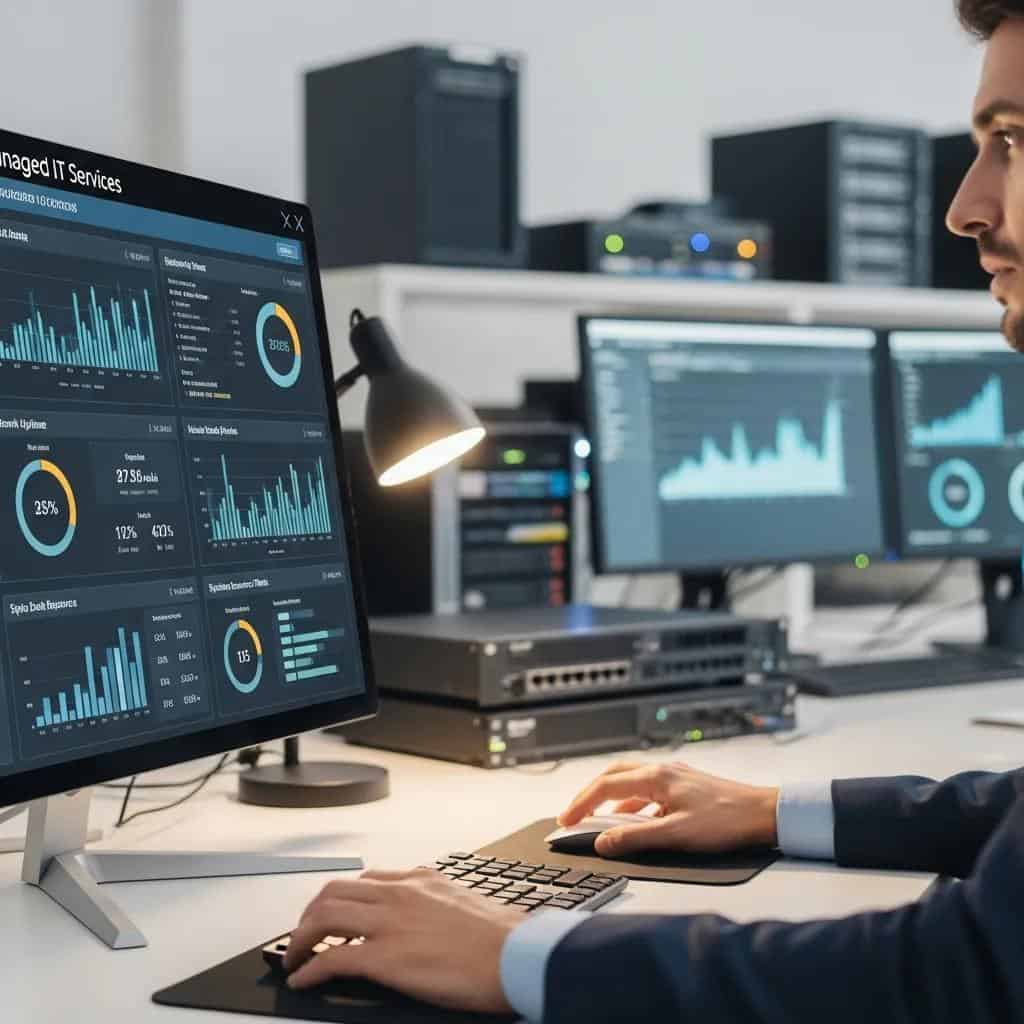
Managed IT services are outsourced IT operations delivered under proactive contracts where a provider takes responsibility for monitoring, maintaining, and improving an organization’s technology stack to achieve specific business outcomes. This model works by combining continuous network monitoring, patch management, endpoint lifecycle services, and a help desk to reduce incidents and enable predictable budgeting. The clear benefit is less unplanned downtime, smoother workflows, and simplified vendor management so leaders can prioritize growth rather than break/fix firefighting. For Baton Rouge businesses that need local responsiveness and cost predictability, managed services offer scalable expertise without the overhead of hiring and training internal teams. Understanding core components helps you compare proposals and evaluate expected outcomes from prospective providers.

Managed services for SMBs commonly include the following core benefits:

  1. Reduced Downtime: Continuous monitoring and rapid remediation lower the frequency and impact of outages.
  2. Predictable Costs: Fixed monthly pricing helps budgeting and avoids surprise emergency expenses.
  3. Improved Productivity: Centralized endpoint management and help desk support reduce user friction and speed issue resolution.

This benefit summary sets up a deeper look at the specific features that produce these outcomes and how those features compare to in-house approaches.

Different managed service components map directly to business outcomes and decision criteria.

ServiceFeature/AttributeBusiness Benefit
Help Desk24/7 remote support and SLAsFaster user recovery and reduced lost productivity
MonitoringNetwork and endpoint monitoring with alertsEarly detection reduces incident scope and MTTR
Patch ManagementScheduled updates and testingFewer security vulnerabilities and compatibility issues
Endpoint LifecycleDevice provisioning and retirementLower TCO and consistent security posture
Backup & DRManaged backups and recovery testingFaster recovery and reduced data loss risk

Key Features of Managed IT Services for Small to Mid-sized Businesses

Managed IT features focus on reliability, security, and usability to meet SMB operational constraints and growth needs. Primary features include a staffed help desk offering triage and remote remediation, proactive monitoring that flags anomalies before users notice, and managed endpoints with patching and antivirus enforcement. Each feature directly reduces administrative burden and exposure to cyber threats while improving end-user satisfaction and retention. Small businesses especially benefit when managed services include lifecycle planning for devices and software, because consistent refresh cycles and centralized configuration prevent fragmentation that leads to support overhead. These capabilities form the foundation for predictable operations and allow organizations to scale technology in line with business priorities.

Key features link to outcomes in measurable ways, which leads into an analysis of cost and downtime reduction that helps decision-makers compare in-house versus managed approaches.

How Managed IT Services Reduce Costs and Downtime

Managed services reduce costs by converting unpredictable, high-cost emergency fixes into predictable monthly operating expenses while lowering the probability of major outages that can generate lost revenue. Mechanisms include scheduled maintenance that prevents failure, remote-first troubleshooting that cuts travel and on-site labor costs, and vendor consolidation that streamlines licensing and support. A direct comparison shows in-house staffing often requires salaries, training, and recruitment risk, while managed services deliver a broader skill set on a stable budget. Finance and operations leaders can translate reduced downtime into revenue protection and compute ROI by estimating avoided outage minutes and the reduced need for overtime or contract technicians.

  • Predictable Budgeting: Fixed monthly fees reduce unexpected capital and emergency support expenses.
  • Lower Risk Exposure: Proactive monitoring prevents incidents before they escalate into costly outages.
  • Operational Efficiency: Centralized management reduces duplication and administrative overhead.

This cost-focused view naturally leads to cybersecurity, where proactive controls further limit downtime and financial impact.

How Do Cybersecurity Services Protect Baton Rouge Businesses?

Cybersecurity services protect Baton Rouge businesses by applying layered defenses—technical controls, monitoring, and human-centric practices—to prevent, detect, and respond to threats that can disrupt operations or expose sensitive data. The protection model combines email filtering, endpoint protection, network segmentation, employee training, and continuous security monitoring so malicious activity is contained before it becomes a business-critical incident. Effective security also integrates incident response plans and compliance checks to ensure regulatory obligations are met and recovery steps are well-rehearsed. That layered approach reduces breach probability, limits impact when incidents occur, and shortens recovery timelines so organizations can resume normal operations quickly.

Top defenses map to measurable outcomes and common threat types, as shown in the table below.

Different threats require specific controls to achieve predictable business outcomes.

Threat TypeProtective MeasureExpected Outcome
Phishing & Social EngineeringEmail filtering + user trainingFewer credential compromises and reduced breach probability
RansomwareEndpoint protection + immutable backupsLower chance of data encryption and faster recovery
Malware & Zero-dayEDR with behavioral analysisEarly detection and containment of novel threats
Insider RiskAccess controls & loggingFaster investigation and minimized data exposure

When comparing security approaches, consider these practical defensive priorities:

  1. Preventive Controls: Hardened endpoints, patching, and least-privilege access reduce the attack surface.
  2. Detect & Respond: Continuous monitoring and playbooks shorten mean time to detect and mean time to remediate.
  3. People & Process: Regular employee training and incident rehearsals ensure human factors are addressed.

Common Cybersecurity Threats Facing Local Businesses

Local businesses face threats similar to national patterns—phishing, ransomware, credential stuffing, and supply-chain compromises—but they also contend with sector-specific risks such as healthcare data exposure or retail card-not-present fraud that carry regulatory and reputational consequences. Phishing remains the leading initial vector and often precedes malware deployment or credential theft, while ransomware attackers target unpatched systems and inadequate backup processes. Small to mid-sized businesses frequently lack dedicated security staff, making layered defenses and managed detection critical to reducing risk. Practical mitigation includes prioritized patching, multi-factor authentication, and employee phishing simulations that together lower the likelihood and potential damage of an attack.

Recognizing these threats naturally points to AI-enhanced defenses that improve detection and speed response cycles, which we cover next.

AI-Driven Cybersecurity Solutions Offered by Wahaya IT

AI-driven cybersecurity augments traditional detection by identifying anomalies in network behavior, prioritizing alerts based on business impact, and automating routine triage to reduce analyst workload and shorten response times. As an example, Wahaya IT integrates managed intelligence and AIOps into security monitoring to surface high-risk incidents faster and enable automated containment for clear-cut threats, which reduces mean time to remediate. This approach pairs algorithmic detection with human oversight so false positives are minimized while the most consequential events receive human analysis. Organizations adopting AI-enabled security benefit from prioritized alerts, scalable monitoring, and faster recovery workflows—making it easier to maintain compliance and reduce disruption.

Mentioning a provider’s AI capabilities helps organizations understand how advanced monitoring fits into their defense strategy and when to request a pilot or assessment.

What Cloud Solutions Are Available for Baton Rouge Businesses?

Cloud solutions for Baton Rouge businesses span public cloud services, private cloud hosting, hybrid models combining on-premises and cloud resources, and SaaS productivity platforms like Microsoft 365 that centralize collaboration and identity management. Each cloud model offers distinct characteristics: public cloud emphasizes scalability and cost efficiency, private cloud offers control and isolation, and hybrid setups deliver a blend that suits legacy systems alongside cloud-native apps. Migrating to the cloud works by assessing workloads, planning data migration, optimizing costs, and implementing governance to maintain security and compliance. For SMBs, the right cloud strategy balances cost, performance, and operational simplicity while enabling remote access and redundancy that improve business continuity.

Choosing between cloud models depends on workload needs and compliance obligations; the table below helps match models to typical SMB use cases.

Cloud ModelKey CharacteristicBest-fit Use Case
Public CloudOn-demand, scalable resourcesWeb applications and variable workloads
Private CloudDedicated infrastructure and controlRegulated data or legacy systems needing isolation
Hybrid CloudMix of on-premises + cloudGradual migration and latency-sensitive apps
Microsoft 365 (SaaS)Integrated productivity & identityCollaboration, email, and lightweight data governance

Benefits of cloud adoption are tangible and measurable for small to mid-sized organizations.

Benefits of Cloud Migration and Management for SMBs

Cloud migration delivers scalability, remote access, redundancy, and the opportunity to convert capital expenditures into operating costs that scale with demand. Proper cloud management includes cost optimization measures like rightsizing and reserved instances, security configuration management, and monitoring to prevent drift and maintain compliance. SMBs gain improved collaboration through shared productivity platforms and simplified disaster recovery via geographically distributed backups. When evaluating cloud migration, organizations should factor in migration complexity, ongoing management costs, and the business value of reduced downtime and faster feature deployment, which collectively determine ROI for moving workloads to the cloud.

Hybrid and Microsoft 365 Cloud Services Explained

A hybrid cloud approach preserves on-premise investments while enabling cloud burst capacity and modern SaaS capabilities, making it ideal for businesses with legacy systems or data residency requirements. Microsoft 365 provides integrated email, Teams, SharePoint, and centralized identity controls that simplify remote work, unify communications, and provide built-in compliance and security features suitable for many SMBs. Managing Microsoft 365 includes license optimization, conditional access, and secure configuration to ensure data protection while enabling productivity. Choosing hybrid versus full cloud depends on latency, regulatory needs, and the cost of refactoring applications—each organization should assess workloads and pilot migrations to validate assumptions.

Understanding migration trade-offs supports selecting the right operational model and informs the next priority: business continuity planning to protect cloud and on-premises assets.

Why Is Business Continuity Planning Essential for Baton Rouge Companies?

Business continuity planning (BCP) is essential because it ensures organizations can maintain critical operations during disruptions—natural disasters, cyber incidents, or infrastructure failures—by defining recovery objectives, backup strategies, and clear roles for response. BCP works by setting Recovery Time Objectives (RTOs) and Recovery Point Objectives (RPOs), implementing backups and redundant systems, and testing procedures regularly so recovery actions are reliable under pressure. For Baton Rouge companies, local risks like severe weather or regional outages make continuity planning a strategic priority that directly protects revenue, reputation, and compliance standing. Establishing a tested plan reduces recovery uncertainty and shortens disruption duration when incidents occur.

A practical table below maps strategies to recovery expectations and helps prioritize investments for typical SMB constraints.

StrategyCharacteristicTypical Recovery Expectation
Onsite Backup + Offsite ReplicationLocal backups with remote copiesFaster local restores; offsite for disaster scenarios
Cloud Backups (encrypted)Managed, versioned backupsLow RPO with faster cloud restores
DRaaS (Disaster Recovery as a Service)Orchestrated failover to cloudNear-zero RPO for critical systems with tested procedures

Below are core reasons every Baton Rouge business should adopt BCP:

  1. Protect Revenue: Faster recovery minimizes lost sales and transactional disruption.
  2. Preserve Reputation: Demonstrable recovery capabilities maintain customer trust after incidents.
  3. Meet Compliance: Documented plans and tested recoveries support regulatory obligations.

These reasons set the stage for specific backup and proactive support strategies that reduce downtime impact.

Data Backup and Disaster Recovery Strategies

Effective backup and DR strategies combine multiple layers—local backups for quick restores, encrypted offsite/cloud copies for disaster scenarios, and periodic recovery testing to verify integrity. Technologies include snapshot-based backups, immutable storage to guard against ransomware, and managed DRaaS options that automate failover for critical workloads. Scheduling backups, validating restore procedures, and encrypting data in transit and at rest are essential practices that reduce both data loss risk and the time required to return to operations. Regular testing and documentation ensure that recovery workflows are reliable and that staff know their roles when executing the plan.

Minimizing Downtime with Proactive IT Support

Proactive IT support minimizes downtime by coupling continuous monitoring, defined SLAs, automated alerts, and incident playbooks that accelerate detection, escalation, and remediation. A typical timeline shows detection via monitoring, automated containment steps for certain events, escalation to human analysts, and restoration from verified backups—each stage governed by SLA targets for response and resolution. Expect SLAs to specify response time, resolution targets, and escalation paths; these commitments enable predictable recovery metrics that leadership can use in risk assessments. When proactive measures are combined with tested DR plans, organizations see shorter outages and fewer business interruptions overall.

Proactive support and continuity planning provide the foundation for strategic IT consulting that aligns technology with growth objectives, covered next.

How Can Baton Rouge Businesses Leverage IT Consulting for Growth?

IT consulting helps Baton Rouge businesses translate technology investments into measurable business outcomes by assessing current environments, defining roadmaps for security and cloud adoption, and identifying process improvements that reduce cost and improve agility. Consulting begins with a structured assessment—inventory, risk analysis, and business alignment—followed by a prioritized roadmap that balances quick wins with longer-term transformations. Consultants also advise on governance, vendor selection, and metrics to track progress against business KPIs. For organizations exploring managed intelligence and AI, consulting helps design low-risk pilots, select metrics, and integrate automation into existing operations in ways that augment staff productivity rather than replace people.

A strategic consulting engagement produces a clear action plan and measurable milestones, which makes implementation and vendor evaluation straightforward.

Tailored IT Strategies for Local Business Challenges

Tailored IT strategies account for local regulatory requirements, sector-specific workflows, and Baton Rouge infrastructure characteristics—like bandwidth constraints or regional backup considerations—to ensure solutions are practical and resilient. For healthcare or retail organizations, this might mean prioritizing HIPAA-ready configurations or secure payment processing integrations; for manufacturers, edge-to-cloud data flows and OT segmentation may be critical. Consultants typically produce anonymized case examples and stepwise assessments that identify compliance gaps, scaling bottlenecks, and cost-saving opportunities. Starting with a focused assessment and pilot phase reduces risk and clarifies the operational impact of recommended changes.

These locally aware strategies naturally lead to integrating AI and managed intelligence in ways that improve operational efficiency and security.

Integrating AI and Managed Intelligence into IT Planning

Integrating AI into IT operations begins with small, measurable pilots—AIOps for anomaly detection, security automation for repetitive triage, or cloud cost optimization engines—and expands based on observed ROI and operational readiness. Metrics like reduced alert volume, faster remediation time, or percentage cost savings from rightsizing cloud resources provide clear signals to scale pilots. AI augments human teams by automating low-value tasks and surfacing prioritized insights for decision-makers, thereby increasing staff productivity and lowering operational risk. Organizations should plan for governance, data quality, and staged rollouts to ensure controlled adoption and alignment with business goals.

For Baton Rouge businesses ready to act, working with a local managed intelligence provider can accelerate pilot design and operational integration.

Wahaya IT, a Baton Rouge managed intelligence provider, offers managed services that integrate AI-enabled monitoring, cybersecurity, cloud migration, Microsoft 365 management, and business continuity planning as practical options for small to mid-sized businesses. For organizations seeking a local partner that blends proactive support with AI-assisted detection and cloud services, Wahaya IT can provide assessments and tailored roadmaps; those interested in a consultation can contact the firm for an initial evaluation of needs and proposed next steps.

This actionable pathway demonstrates how consulting, managed services, and AI combine to produce measurable operational improvements and reduced risk for Baton Rouge companies.